

HealthTech innovations are creating breakthroughs quite frequently. But, for every breakthrough, a fundamental challenge remains, which is safeguarding patient data. The regulatory landscape is a minefield, and a single misstep can lead to catastrophic financial and reputational damage. Ignoring compliance is not worth the risk, as you want to earn the trust of the clients.
Healthcare has held the unfortunate title of the industry with the highest data breach costs for 14 consecutive years. In 2024, the average cost of a healthcare data breach was a staggering $9.8 million. That’s more than double the global average for other industries. You need to understand that this isn’t just about fines but the erosion of trust, disrupted patient care, and a complete loss of business

1. The Regulatory Pillars You Must Know
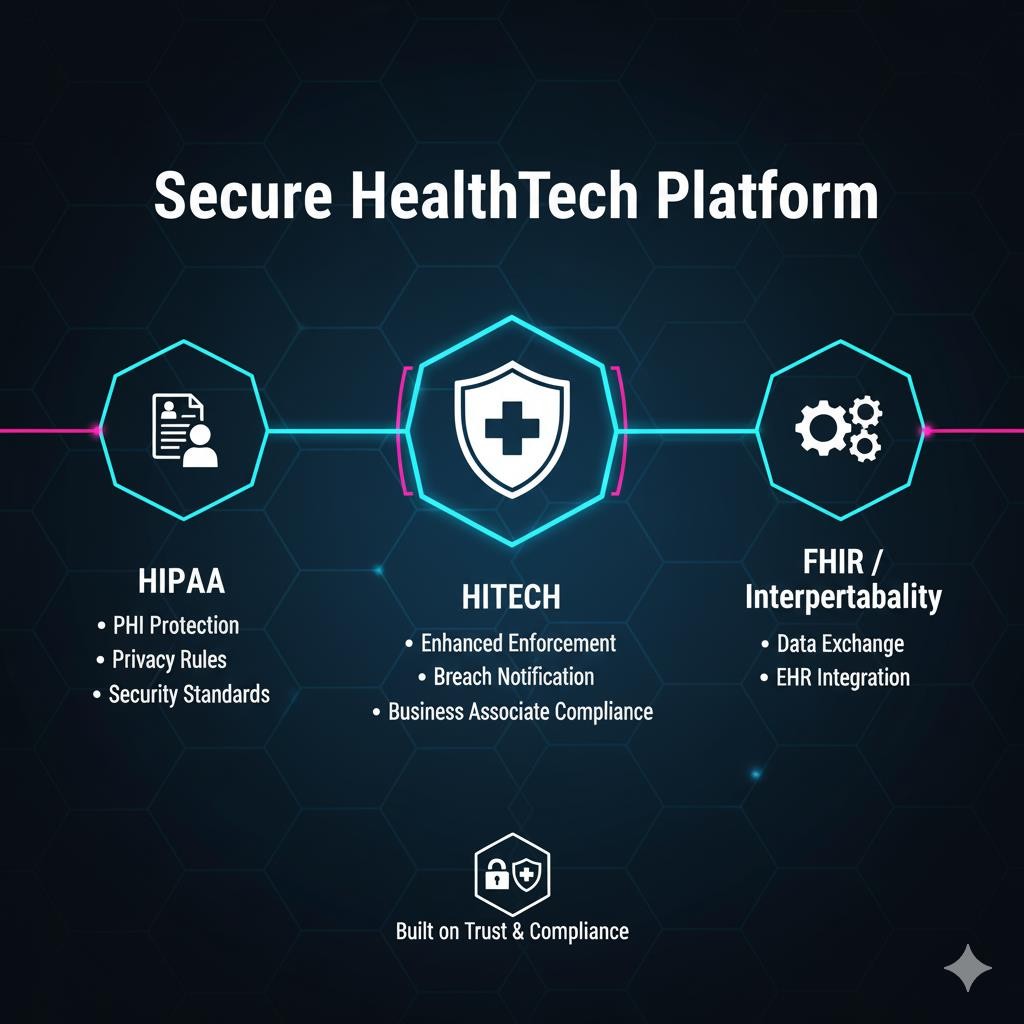
At the heart of U.S. HealthTech compliance are two pivotal acts – HIPAA and HITECH. You need to grasp their roles to build a resilient and secure platform.
HIPAA (Health Insurance Portability and Accountability Act):
This is the foundation. It sets the rules for the protection of Protected Health Information (PHI). PHI includes everything from a patient’s name and birth date to their lab results and insurance information. The law outlines a strict framework for who can access this data and how it can be used.
HITECH (Health Information Technology for Economic and Clinical Health Act):
Think of HITECH as a powerful enhancement to HIPAA. Passed in 2009, it amplified penalties for violations and introduced new reporting requirements. Crucially, it made business associates (like your cloud providers or software vendors) directly accountable for HIPAA compliance.
Beyond these two, you must keep an eye on emerging standards like FHIR (Fast Healthcare Interoperability Resources). This standard is designed to improve data exchange and interoperability, a key to future-proofing your platform.
2. A Blueprint for Building a Secure HealthTech Platform
Compliance is a strategic pillar of your product development from day one. Here’s how you build a platform that’s secure by design.
1. Architect for Impregnable Security
Your platform’s security is only as strong as its weakest link. You must implement robust technical safeguards:
- Encryption Everywhere: All PHI must be encrypted, both when it’s moving between systems (in transit) and when it’s stored on servers (at rest). This is your first line of defense.
- Zero-Trust Access Controls: Don’t assume anyone is trustworthy. Implement a zero-trust model with multi-factor authentication (MFA) and strictly role-based access to PHI. If an employee doesn’t need to see a patient’s data to do their job, they shouldn’t have access to it.
- Cloud Security: Partner with a cloud provider that has a proven track record of handling sensitive data and offers comprehensive security features. Make sure you understand the shared responsibility model—your provider secures the infrastructure, but you are responsible for securing your data on it.
- Cloud Security: Partner with a cloud provider that has a proven track record of handling sensitive data and offers comprehensive security features. Make sure you understand the shared responsibility model—your provider secures the infrastructure, but you are responsible for securing your data on it.
2. Vet and Manage Your Vendors
Your legal responsibility for PHI doesn’t end when you hand it over to a third-party service. You are accountable for your vendors’ compliance as well. Always ensure you have a signed Business Associate Agreement (BAA) with any service that handles PHI on your behalf. This legally binding contract ensures they meet the same security and privacy standards you do.
3. Prepare for the Breaches
It’s not a matter of if a breach will happen, but when. The key is to be prepared to respond effectively and minimize the damage.
- Constant Monitoring: Implement continuous monitoring to detect unusual activity. Phishing attacks, stolen credentials, and other security incidents are common entry points for breaches. In 2023, a staggering 80% of data breaches were caused by hacking incidents.
- Create a Response Plan: You must have a clear, documented incident response plan. This plan should detail the steps for containing a breach, investigating its cause, notifying affected individuals, and reporting the incident to the Office for Civil Rights (OCR). Getting this right can save you millions, for example, breaches identified and contained in less than 200 days cost an average of $1.39 million less than those that take longer.
3. The Human Element - Building a Culture of Compliance
Technology alone cannot solve the problem of data security. You must build a culture where every team member understands their role in protecting patient information. The most common HIPAA violations often stem from human error, such as unauthorized access or accidental disclosure. What to do to avoid these errors? Follow below steps:
Mandatory Training: Provide regular, engaging training for all employees on privacy policies, secure data handling, and the importance of compliance. Use real-world examples to illustrate the consequences.
Documentation is Key: Maintain meticulous documentation of all your security policies, procedures, and internal audits. This is your proof of due diligence and is crucial for demonstrating compliance to regulators.
By weaving these principles into the very fabric of your organization, you build a trustworthy and sustainable HealthTech business, along with creating a compliant product.
Conclusion
We at Dynamisch, have expertise in creating the best healthcare projects that are trusted by the USA government and FBI. Let us know if you have such requirements and we will be happy to develop the best-in-class solution for you. Check out the case studies to learn more.