
Salesforce’s place on top of the CRM world is no coincidence as it offers simplicity to many business operations. Whenever businesses chase deeper personalization, automation, and data-driven results, Salesforce keeps raising the bar. Here’s a look at ten Salesforce features that are set to lead the market, coupled with compelling statistics and future-focused analysis to help you traverse the CRM field through 2027.
1. Agentforce - Autonomous AI Agents for Business Processes
Agentforce is Salesforce’s flagship digital labor solution, empowering organizations to deploy autonomous AI agents across all departments. These agents can handle everything from routine customer questions to complex workflow orchestration.
Modern travel companies have trimmed average handling time by 15% and expect $2million in annual cost savings. Some firms foresee Agentforce autonomously resolving up to 20% of inquiries, cutting the workload for human reps in half.
2025 updates include employee-facing agents for workflow execution, new visual/media responses, multimodal input (images, files), and real-time web search within Agentforce Data Library for richer support.
2. Einstein Copilot and GPT: Conversational AI and Deep Personalization
Salesforce’s Einstein Copilot, which is fully integrated across all clouds, leverages conversational AI for both customer- and employee-facing use-cases. In 2025 and beyond, the platform enables instant recommendations, hands-free opportunity scoring, and personalized outbound communications.
Einstein GPT now generates uniquely tailored marketing messages and service responses, boosting engagement rates and trust, all while keeping data governance at the forefront.
AI-powered CRMs such as Salesforce are forecasted to drive the market from $112.9billion in 2025 to over $130billion by 2027, fueled largely by innovations in conversational automation.
3. Zero-Click Forecasting and Smart Analytics
Thanks to machine learning, Salesforce offers always-accurate forecasts without manual intervention. Zero-Click Forecasting automatically refreshes sales predictions based on the latest data, which can be further used for fine-tuning.
Sales leaders report up to 20% faster decision cycles and more accurate projections, a crucial edge in turbulent markets.
4. Real-Time Data Cloud
Data Cloud (formerly Salesforce CDP) has advanced to enable real-time streaming, zero-copy data sharing, and deep AI integration. Through 2027, organizations are using these features to merge data from every system for dynamic insights and instant personalization.
Salesforce continues to be recognized as a leader in Customer Data Platforms globally, because of the unified data, real-time processing, and flexible data sharing.
Sectors like retail, financial services, and healthcare are seeing the biggest lift by speeding up campaign responsiveness and hyper-targeting.
5. Hyper automation with Flow 2.0
Flow Automation has taken low-code process creation to the next level. Users can now automate multi-step approvals, integrate third-party tools like Slack or Teams, and employ AI-powered suggestions for building workflows in minutes.
Flow Approval Processes let organizations automate even the most complex ops, while new debugging tools cut troubleshooting time by half.
6. Industry-First Tailored Clouds
Salesforce platform has expanded its Industry Clouds, Health Cloud, Financial Services Cloud, Manufacturing Clouds to include regulatory compliance features, automated underwriting, and industry-specific automation.
For example, healthcare providers can automate patient onboarding, while insurers use AI tools for real-time claims analytics and compliance management.
Industry-specific CRMs are among the fastest-growing segments and are core to Salesforce’s market leadership through 2027.
7. AI Campaign Optimization and Omnichannel Engagement
Marketers can leverage predictive recommendations to optimize campaigns, deploy them across WhatsApp and other platforms, and use custom templates for faster rollouts.
Companies using Salesforce Marketing AI have reported up to 25% higher conversion rates with hyper-targeted, multi-channel outreach.
By 2027, messaging and omnichannel will become non-negotiable for all large-scale campaigns.
8. Enhanced Integration and Automation with MuleSoft
MuleSoft’s embedded tools let admins and developers connect anything, whether it’s SAP, Oracle, bespoke apps, or cloud systems, just by using clicks, not code. Automation now reaches across every company’s tech stack, supporting rapid transformation and real-time integration.
9. Mobile and Low-Code Innovation
New features like Dynamic Related Lists for mobile and Lightning Web Component (LWC) for local development support, let teams work wherever, whenever, and however they like. User interfaces and controls are sharper, more intuitive, and ready for the evolving nature of remote and hybrid work.
10. ESG and Sustainability Leadership (Net Zero Cloud)
More organizations are tracking, reporting, and improving their environmental impact using Net Zero Cloud. By aligning with new standards and automating compliance, Salesforce positions itself as the CRM for a sustainable future.
Companies adopting these tools are seeing improved brand trust, higher customer satisfaction, and better regulatory compliance.
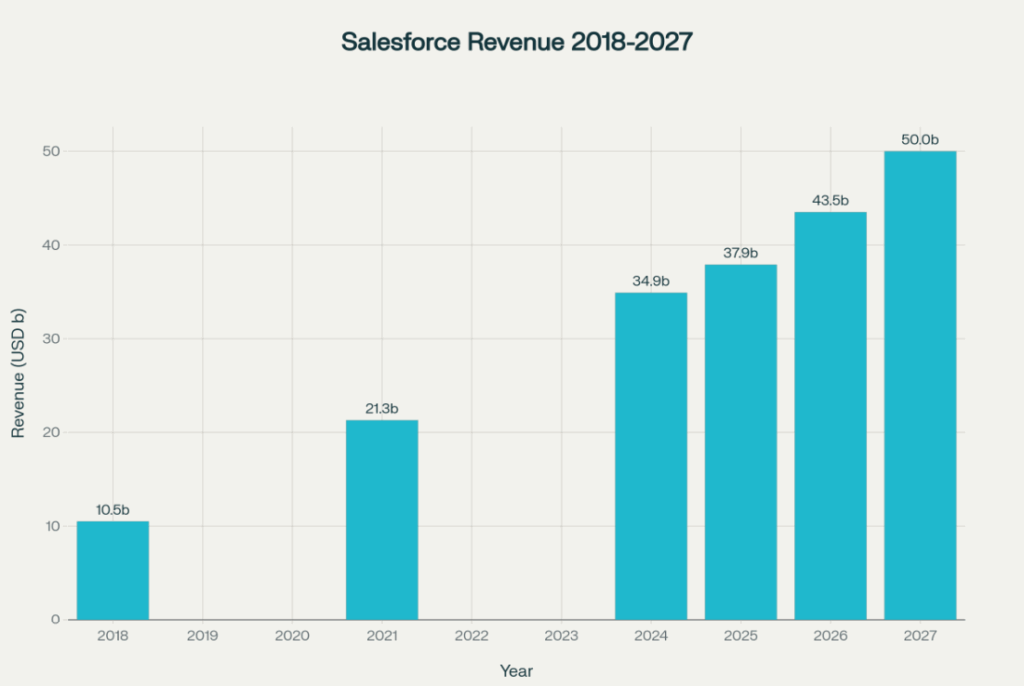
Year | Revenue (USD Bn) | CRM Market Share (%) | Number of Customers | Regions Led |
2025 (est.) | 37.8–38.0 | 21.7–26.1 | 150,000+ | Americas, Europe, APAC |
2026 (proj.) | 42–45 | 23–27 (est.) | 160,000+ (est.) | All global |
2027 (proj.) | ~50 | 25–30 (est.) | 170,000+ (est.) | All global |
CRM Market Projection for 2025–2027
Global CRM market to reach $130billion by 2027, up from $112.9billion in 2025, with Salesforce maintaining the lead.
AI-powered CRM solutions to account for over 60% of new CRM deployments by 2027, with Salesforce at the center.
Key Takeaways for the Next Two Years
- Agentforce AI agents will power both customer and employee experiences, automating up to 20–25% of tasks by end-2027.
- Data Cloud will become the backbone of real-time, data-driven engagement across every major industry.
- Industry Clouds and ESG will push Salesforce further into specialized, high-compliance markets.
- Mobile and integration advances will ensure teams stay productive and connected in a distributed world.
- AI-driven marketing and sales tools will be the deciding factor for competitive advantage, and Salesforce is leading the charge.
Why These Trends Matter
Salesforce is morphing into a converged ecosystem for everything revenue, support, and sustainability focused. As new features mature and businesses push for more automation, using Salesforce is quickly transitioning from an option to a necessity.
With the right strategy, these tools will help businesses nurture deeper customer relationships, unlock new efficiencies, and future-proof their success well into 2027 and beyond.
We, at Dynamisch, have certified Salesforce experts that have helped us deliver solutions worth billions. Read more about that here.